VIP Peptides · Research Compound
Kisspeptin Research Profile
Kisspeptin, also known as metastin, is a family of neuropeptides encoded
by the KISS1 gene. Kisspeptin-54 is the longer form used in many human
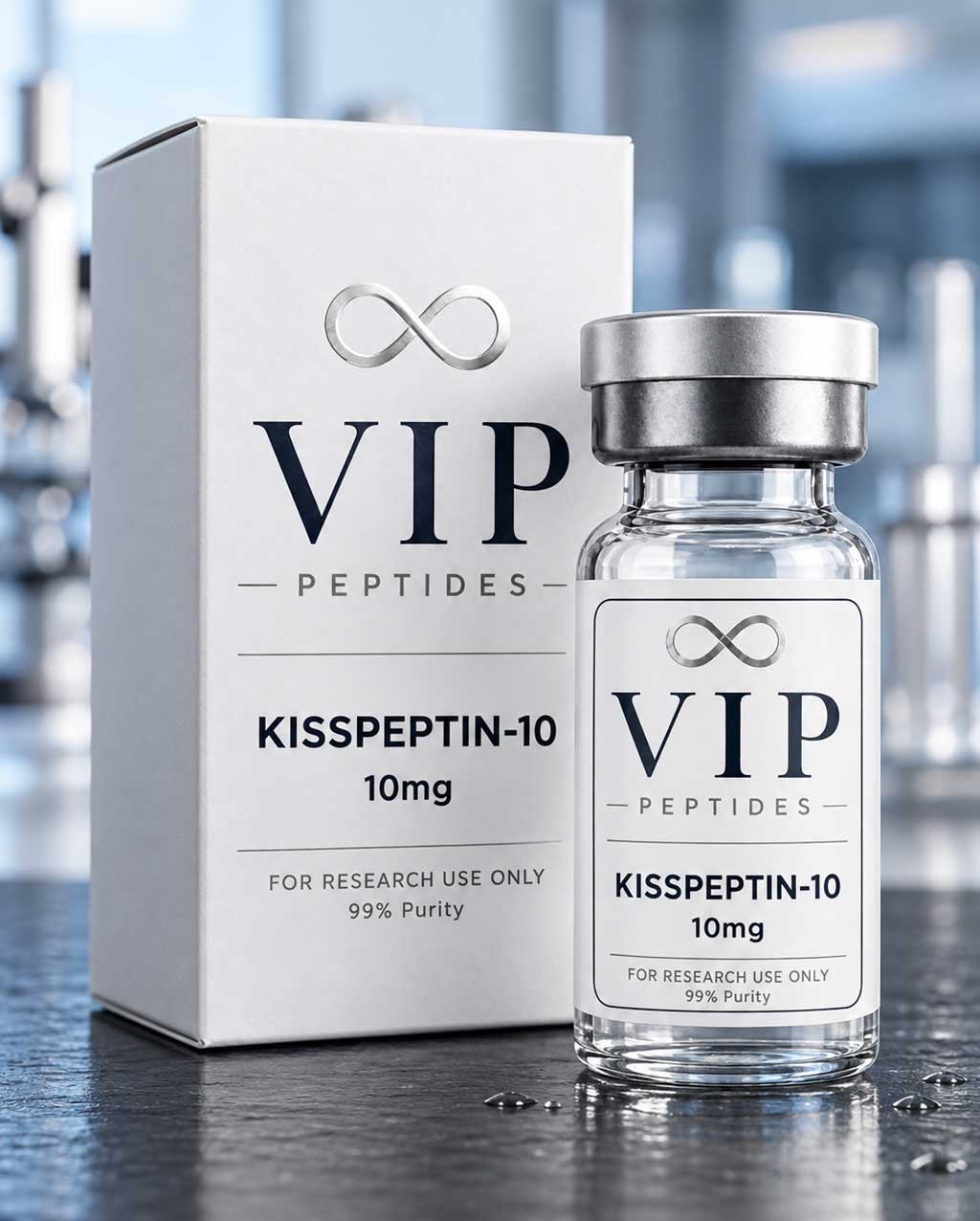
studies; Kisspeptin-10 is a shorter C-terminal fragment commonly sold
as a research peptide.
Encodes kisspeptin peptides
Shorter research form
Primary research focus
Not FDA-approved
Product Information
About Kisspeptin
Kisspeptin acts upstream in the hypothalamic-pituitary-gonadal
(HPG) axis. It binds to the KISS1R receptor on hypothalamic GnRH
neurons and can trigger gonadotropin-releasing hormone (GnRH)
release. GnRH then signals the pituitary to release luteinizing
hormone (LH) and follicle-stimulating hormone (FSH), which
influence gonadal sex-hormone production.
Genetic findings support the pathway’s role in puberty and
reproductive function: loss-of-function KISS1/KISS1R mutations
are associated with hypogonadotropic hypogonadism, while certain
activating mutations are associated with precocious puberty.
Research Overview
| Compound | Kisspeptin / metastin |
|---|---|
| Encoded by | KISS1 gene |
| Research forms | Kisspeptin-54 and Kisspeptin-10 |
| Receptor | KISS1R / GPR54 |
| Primary pathway | Hypothalamic-pituitary-gonadal axis |
| Regulatory status | Not FDA-approved for any indication |
Evidence & Research
What Human Studies Have Examined
Reproductive Hormone Signaling
Human studies, primarily involving Kisspeptin-54 and some
Kisspeptin-10, have reported acute increases in LH, FSH and
downstream sex hormones in healthy men and in some women with
hypothalamic amenorrhea.
Assisted Reproductive Research
Kisspeptin has been studied as a trigger for oocyte maturation
in IVF. Research has explored whether this approach may carry
a lower risk of ovarian hyperstimulation syndrome (OHSS) than
traditional hCG triggers.
Sexual Processing & Desire
Placebo-controlled studies in men and women with hypoactive
sexual desire disorder (HSDD) have examined brain activity in
sexual-processing networks. A study in men also reported
increased penile rigidity in response to sexual stimuli.
These findings do not establish a treatment for HSDD.
HPG-Axis Assessment
Kisspeptin is also being studied for its potential diagnostic
role in assessing hypothalamic-pituitary-gonadal axis function.
This remains a research application.
Evidence Limitations
Response May Change with Repeated Exposure
Continuous or frequent exposure may lead to tachyphylaxis, meaning
the LH/FSH response can diminish over time. Research has therefore
examined intermittent or pulsatile approaches.
Long-term evidence for sustained testosterone restoration, fertility
outcomes or lasting changes in sexual function remains limited.
Results from Kisspeptin-54 studies should not automatically be
treated as evidence for a Kisspeptin-10 research vial.
Safety & Regulatory Status
Important Limitations
Short-term human studies generally describe kisspeptin as tolerated,
with possible mild effects such as injection-site reactions, flushing
or transient headache. Serious adverse events have been rare in
published acute studies, but this does not establish long-term safety.
Repeated exposure may reduce the hormonal response through
tachyphylaxis. The long-term safety database for chronic use is limited.
Kisspeptin is not FDA-approved for any indication. In 2024, the FDA’s
Pharmacy Compounding Advisory Committee voted against recommending
Kisspeptin-10 for inclusion on the 503A Bulk Drug Substances List,
citing insufficient safety and efficacy evidence. Kisspeptin and its
agonist analogues are prohibited under the WADA Prohibited List.
consumption, clinical use, diagnosis, treatment, cure, mitigation or
prevention of disease.

![KISSPEPTIN-10 [10mg]](https://vipresearchpeptides.com/wp-content/uploads/2026/10/kiss.jpg)
![GLP1S [30mg]](https://vipresearchpeptides.com/wp-content/uploads/2026/10/glp1s-300x300.jpg)


![GHK-Cu (glycyl-L-histidyl-L-lysine copper complex) [100mg]](https://vipresearchpeptides.com/wp-content/uploads/2026/10/ghk-300x300.jpg)
Reviews
There are no reviews yet.