Muscle Protein Signaling
Cell and animal studies have examined protein synthesis, satellite
cell activation and myoblast proliferation. These findings do not
show that IGF-1 LR3 produces muscle growth in people.

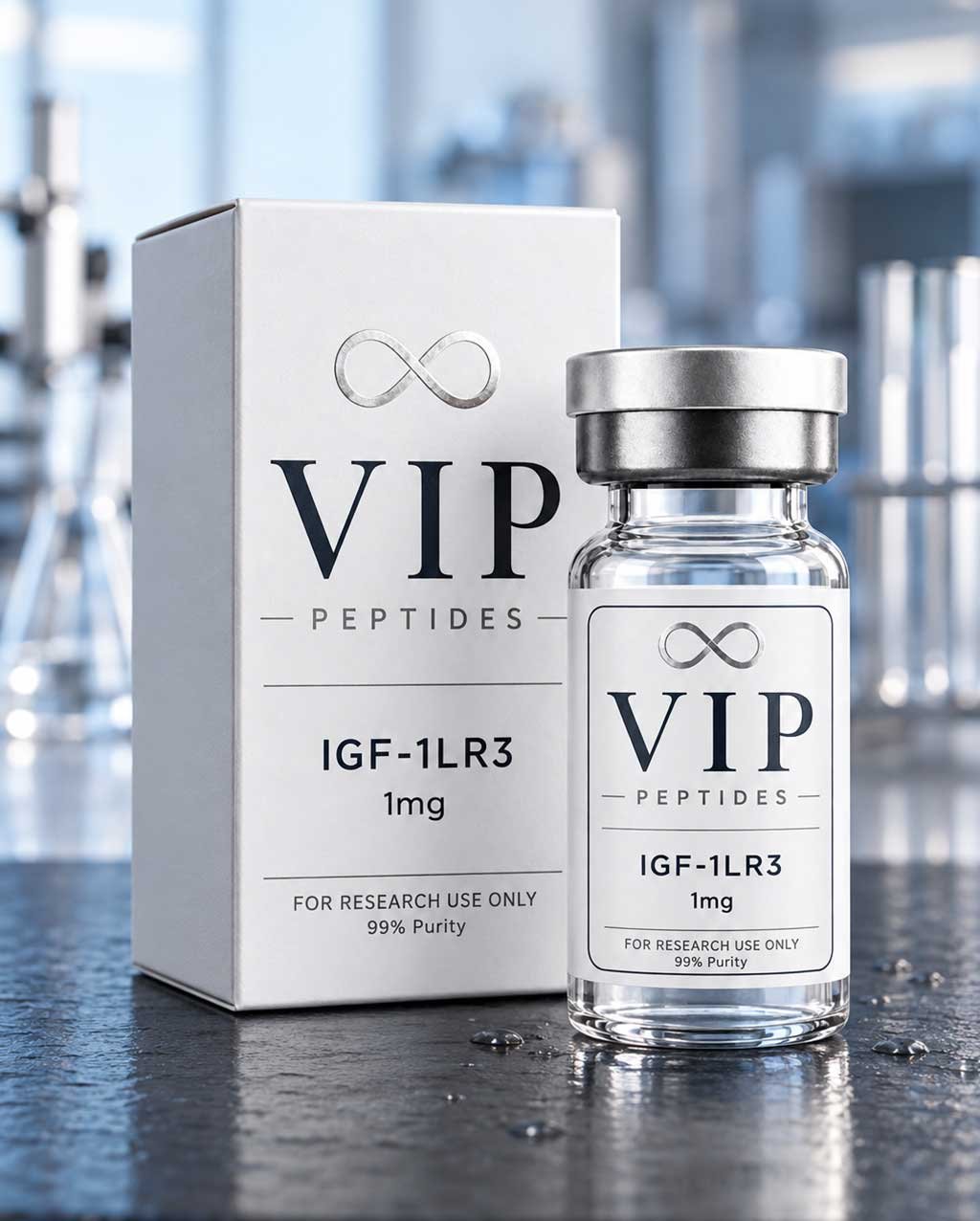
$80.00
IGF-1 LR3 is a synthetic IGF-1 analog studied mainly in cell and animal models for growth and metabolic signaling. Human performance benefits and long-term safety are unestablished; its insulin-like activity raises concern about low blood sugar. This 1 mg vial is a research product, not an FDA-approved medicine.
For laboratory research only. Not for human or animal consumption.
VIP Peptides · Research Compound
IGF-1 LR3 (Long Arg3 Insulin-like Growth Factor-1) is an 83-amino-acid
synthetic analog of human IGF-1. It has an arginine substitution at
position 3 and a 13-amino-acid N-terminal extension. This profile covers
the 1 mg research vial.
Product Information
The two structural modifications reduce binding to IGF-binding
proteins. This is intended to increase free availability and extend
biological activity compared with native IGF-1.
IGF-1 LR3 activates the IGF-1 receptor and related PI3K/Akt/mTOR and
MAPK/ERK signaling pathways, which are involved in protein synthesis
and cell growth. It also has some activity at the insulin receptor.
These mechanisms do not establish human performance benefits.
| Product | IGF-1 LR3 |
|---|---|
| Full name | Long Arg3 Insulin-like Growth Factor-1 |
| Peptide length | 83 amino acids |
| Vial quantity | 1 mg |
| Evidence base | Primarily preclinical |
| Regulatory status | Not FDA-approved for any indication |
Research Areas
Cell and animal studies have examined protein synthesis, satellite
cell activation and myoblast proliferation. These findings do not
show that IGF-1 LR3 produces muscle growth in people.
Experimental models have investigated muscle hypertrophy, increases
in cell number and possible effects on muscle atrophy. Human efficacy
and appropriate clinical use remain unestablished.
Research has examined glucose uptake in muscle and adipose tissue.
Because IGF-1 LR3 has insulin-like activity, changes in blood glucose
are a significant safety consideration.
Muscle recovery, atrophy prevention and body composition have been
explored in preclinical research. Claims of recovery or performance
benefits in humans are not established by large controlled trials.
Evidence Limitations
Evidence is almost entirely from cell culture and animal studies. Large
controlled human trials have not established IGF-1 LR3’s efficacy for
anabolic or performance outcomes.
Human efficacy, a validated dose and long-term safety remain
unestablished. Native IGF-1 medicines have their own clinical
indications and safety information; that does not establish the safety
of this research analog.
Safety & Regulatory Status
The main acute concern is hypoglycemia (low blood sugar) due to
insulin-like activity. Symptoms can include sweating, tremor and
confusion, and severe episodes can be dangerous. Other concerns may
include injection-site reactions, fluid retention and possible
cell-growth effects with prolonged exposure.
IGF-1 LR3 is not FDA-approved for any indication. FDA records state that
IGF-1 LR3 is not an FDA-approved human drug and is not on the 503A bulk
substances list for compounding.
IGF-1 and its analogs are prohibited at all times under the WADA
Prohibited List.
Age & Policy Confirmation
Please confirm your age and review the policies before entering.
Reviews
There are no reviews yet.