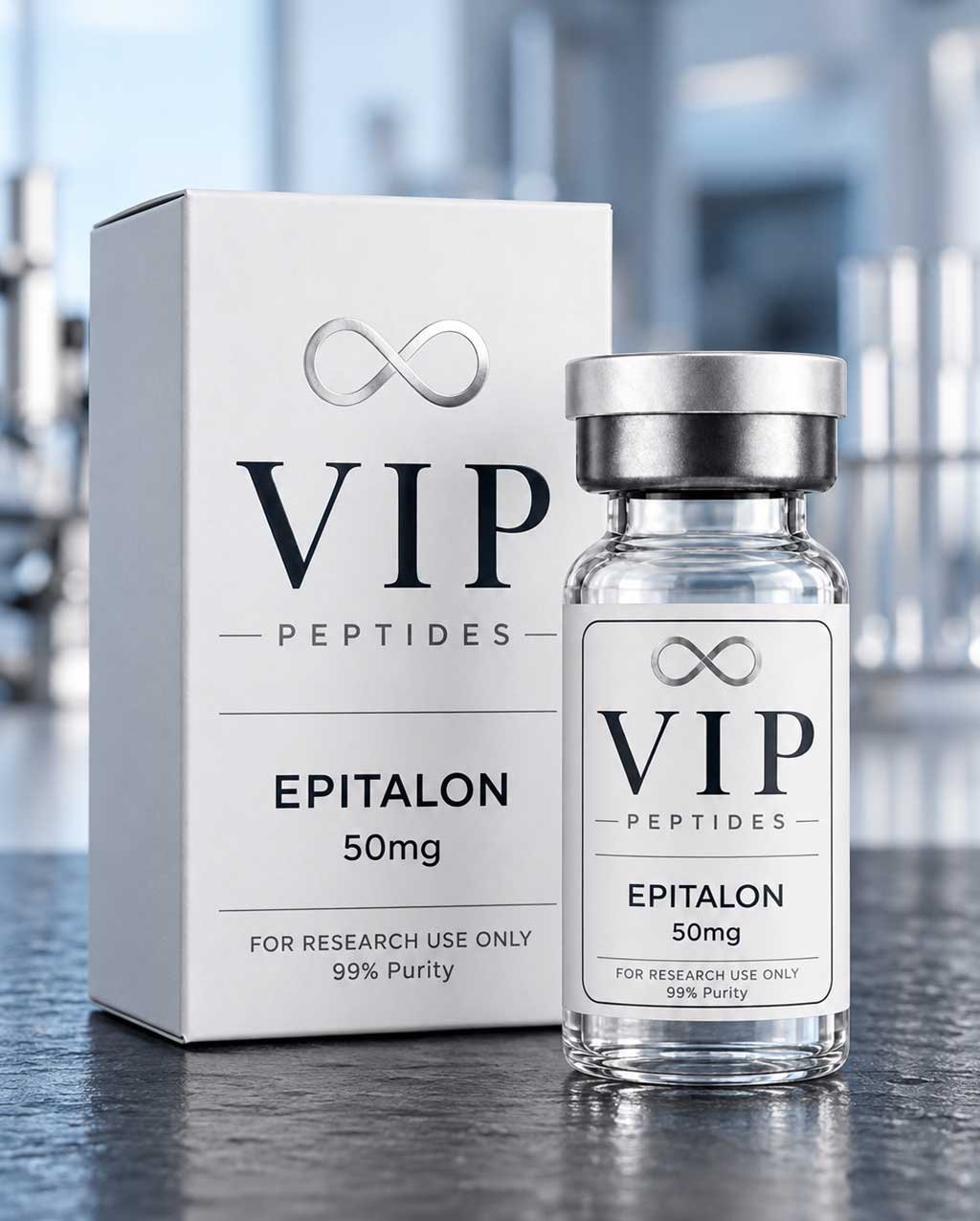
Epitalon (AEDG) is a synthetic tetrapeptide studied in cell and animal research on telomerase, pineal signaling, and aging-related pathways. Human safety and clinical benefits have not been established. For laboratory research only.
⚗RESEARCH USE ONLY
Laboratory research
▤BATCH DOCUMENTATION
Not currently available
◈PRODUCT FORMAT
10 mg · Lyophilized powder
For laboratory research only. Not for human or animal consumption.
Epitalon, also spelled Epithalon or Epithalone, is a synthetic
tetrapeptide studied in cell and animal research on telomerase,
pineal signaling, and aging-related pathways. Research findings do
not establish anti-aging effects in humans.
Ala-Glu-Asp-Gly Peptide sequence
4 Amino Acids Tetrapeptide
Pineal Peptide Research Research area
Research Use Only Product classification
Product Information
About Epitalon
Epitalon is a synthetic tetrapeptide with the sequence Ala-Glu-Asp-Gly (AEDG). It is associated with
research on epithalamin, a pineal-gland peptide complex. Epitalon
and epithalamin are different materials and their findings should
not be treated as interchangeable.
Proposed research mechanisms include effects on telomerase-related
activity, melatonin and circadian signaling, antioxidant pathways,
and gene expression. These mechanisms remain under investigation.
Findings in cultured cells do not show that Epitalon lengthens
telomeres, extends lifespan, or improves health in living people.
Studies in cultured human cells have reported changes in
telomerase-related activity and telomere length. These are
laboratory findings; they do not demonstrate telomere lengthening
or anti-aging benefits in people.
Animal Aging Models
Animal studies involving Epitalon or related pineal preparations
have reported changes in lifespan or age-related measures in some
models. Results can vary by species, preparation, and study design;
they do not establish longer lifespan in humans.
Pineal and Circadian Pathways
Research has examined possible effects on melatonin production
and circadian signaling. Some human observations involved
epithalamin, a multicomponent extract, rather than pure synthetic
Epitalon.
Evidence Limitations
Large independent clinical trials of synthetic Epitalon are lacking.
Human safety, effective dosing, long-term outcomes, and effects on
lifespan or age-related disease have not been established.
Evidence Overview
Cell and Animal Findings Are Not Human Outcomes
Published research includes cell-culture experiments, animal studies,
and limited human observations. Results involving epithalamin or
combined peptide protocols cannot automatically be attributed to
synthetic Epitalon alone.
Telomere, lifespan, sleep, antioxidant, and neuroendocrine claims
remain unconfirmed as clinical benefits of Epitalon in people.
Safety & Regulatory Status
Important Safety Information
Human safety data for Epitalon are limited. Mild injection-site
reactions have been reported in uncontrolled use, but this does not
establish a complete safety profile or predict long-term effects.
Epitalon is not FDA-approved for any indication. FDA has identified
potential immunogenicity concerns for compounded Epitalon, including
risks related to aggregation and peptide impurities, and states that
it lacks enough safety information to know whether compounded products
could cause harm when administered to humans.
For laboratory research only. Not intended for human or animal
consumption, self-administration, diagnosis, treatment, cure, mitigation,
or prevention of disease.
Reviews
There are no reviews yet.
Be the first to review “Epitalon [50mg]” Cancel reply


Reviews
There are no reviews yet.