KPV
Listed in the source document as an example for which
preservative-free sterile water may be specified.

$10.00
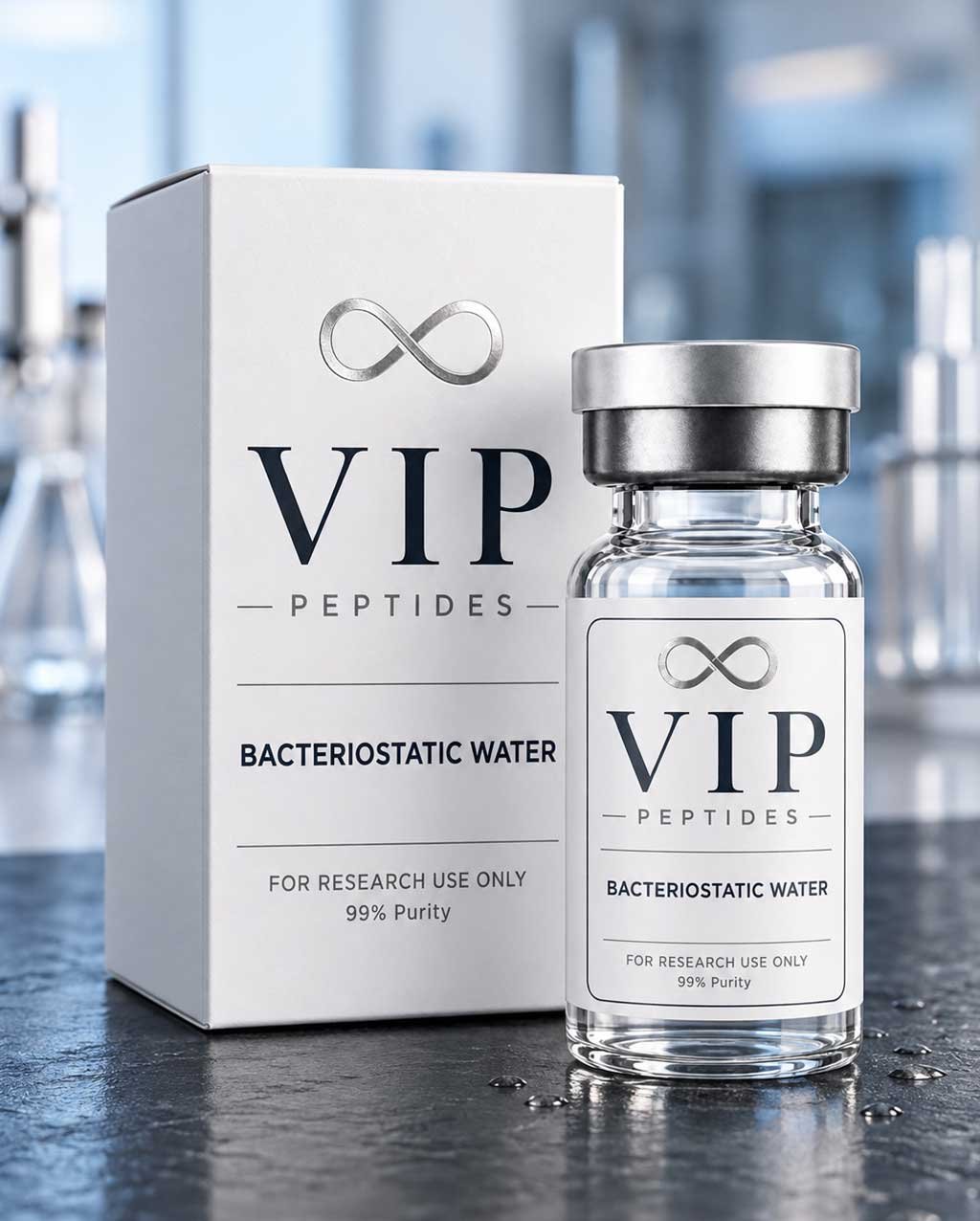
Bacteriostatic Water for Injection (BAC Water/BWFI) is sterile water containing 0.9% benzyl alcohol as a bacteriostatic preservative. It is commonly used as a diluent when the specific product instructions call for it. It is different from preservative-free Sterile Water for Injection; compatibility and storage depend on the product label.
For laboratory research only. Not for human or animal consumption.
VIP Peptides · Research Solvent
Bacteriostatic Water for Injection, also called BAC Water or BWFI,
is sterile water containing benzyl alcohol as a bacteriostatic
preservative. The supplied document specifies 0.9%. It is commonly
supplied in multi-dose containers and is different from preservative-free
Sterile Water for Injection.
Product Information
Bacteriostatic Water for Injection is sterile water with benzyl
alcohol added as a bacteriostatic preservative. The preservative
inhibits bacterial growth in a container labeled for multiple
withdrawals; it does not make the contents or handling process
risk-free.
The supplied document describes BAC Water as a commonly used
diluent for compatible lyophilized research peptides. It is
typically clear and colorless and may be sold in different
container sizes, including 10 mL, 20 mL or 30 mL. Availability
and vial size depend on the specific product.
Always check the vial label and the technical instructions for
the exact compound. Some products may be sensitive to benzyl
alcohol and require a different diluent.
| Product | Bacteriostatic Water for Injection |
|---|---|
| Also called | BAC Water / BWFI |
| Composition | Sterile water with benzyl alcohol preservative |
| Concentration in source | 0.9% benzyl alcohol |
| Appearance in source | Clear and colorless |
| Compatibility | Compound- and product-specific |
Solvent Comparison
| Feature | Bacteriostatic Water | Sterile Water |
|---|---|---|
| Composition | Sterile water with benzyl alcohol preservative |
Sterile water with no bacteriostat or antimicrobial agent in standard Sterile Water for Injection labeling |
| Bacterial protection |
Benzyl alcohol inhibits bacterial growth in a properly labeled multi-dose container |
No antimicrobial preservative |
| Container use | Multi-dose only when the product is labeled for that use | Commonly supplied as a single-dose container |
| Source document’s use context | Most compatible peptides | Some benzyl-alcohol-sensitive compounds |
| After opening | Follow the container’s labeling and beyond-use instructions |
Follow the product label; single-dose products are not multi-dose substitutes |
A multi-dose designation and beyond-use period must come from the
product’s labeling. The source document’s general “up to 28 days”
statement should not be applied automatically to every vial or to
a peptide after it has been reconstituted.
Compatibility Notes
The supplied document identifies the following as examples that may
be sensitive to benzyl alcohol and may require preservative-free
sterile water, depending on the exact formulation:
Listed in the source document as an example for which
preservative-free sterile water may be specified.
Listed in the source document as an example for which
preservative-free sterile water may be specified.
Listed in the source document as an example for which
preservative-free sterile water may be specified.
The source notes that diluent requirements may vary between
formulations. Check the exact product documentation.
The document says to treat a preparation made with sterile water as
single-use and gives a 24-hour discard period. Actual handling must
follow the exact product’s labeling and qualified technical
instructions.
The source also cautions against tap water, distilled water or any
non-sterile liquid for peptide preparation.
Storage Reference
The source’s storage chart estimates: unopened lyophilized powder
may last 1–2 years refrigerated at 2–8 °C or 2–3+ years at −20 °C;
peptide prepared with BAC Water may last up to 28–30 days
refrigerated; peptide prepared with sterile water should be used
within 24 hours; and an opened BAC Water vial may last up to 28 days.
These are general estimates from the supplied document, not
guaranteed shelf lives. Peptide stability after preparation is
product-specific and is not established by the diluent’s
multi-dose status. Follow the exact label, expiry date and
supplier’s technical guidance.
The source also advises protection from light and avoiding
freeze-thaw cycles for prepared peptide solutions. Those
instructions must be confirmed for the specific product.
Source Chart Reference
The supplied document contains a chart mapping vial amounts and
water volumes to concentrations and U-100 syringe measurements.
Those preparation calculations are not reproduced here. The general
concept stated in the source is that adding a different volume of
water changes concentration, not the total amount of material in
the vial.
Handling & Safety
The source document includes a materials list and step-by-step
instructions for preparing peptide vials, along with handling
practices involving sterile syringes, alcohol swabs, vial labeling,
clarity checks, refrigeration and sharps disposal. These procedural
instructions are not reproduced in this product description.
BAC Water contains benzyl alcohol and is not interchangeable with
preservative-free Sterile Water. Some compounds may be incompatible
with benzyl alcohol. Never assume a solvent is suitable based only
on a general peptide list; check the specific product documentation.
Age & Policy Confirmation
Please confirm your age and review the policies before entering.
Reviews
There are no reviews yet.