Acetic Acid Water for Peptide Reconstitution
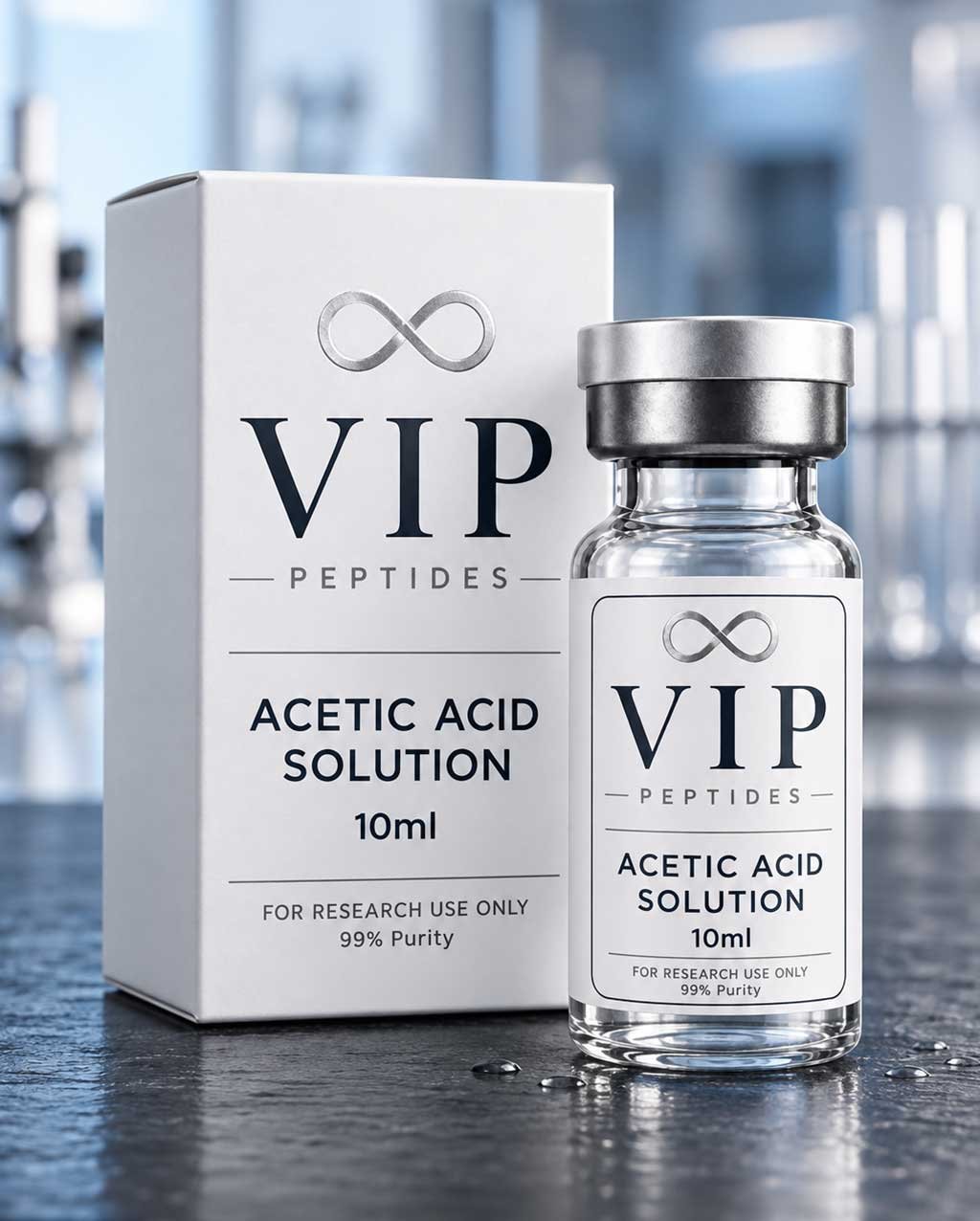
Acetic Acid Water
Acetic acid water (often called AA water) is a dilute solution of acetic
acid in sterile water, typically prepared at a concentration of 0.6%.
This creates a mildly acidic environment with a pH of approximately
3.0–4.0. It is not the same as household vinegar or food-grade acetic
acid. Research-grade acetic acid water is manufactured under sterile
conditions and pre-diluted to the correct concentration for laboratory
use.
0.6%
Acetic acid concentration
pH 3.0–4.0
Approximate pH
No Benzyl Alcohol
Acetic acid water component
Research Use
Educational and research reference
Product Information
What Is Acetic Acid Water?
Acetic acid water (often called AA water) is a dilute solution of
acetic acid in sterile water, typically prepared at a concentration
of 0.6%. This creates a mildly acidic environment with a pH of
approximately 3.0–4.0.
It is not the same as household vinegar or food-grade acetic acid.
Research-grade acetic acid water is manufactured under sterile
conditions and pre-diluted to the correct concentration for
laboratory use.
Product Overview
| Product |
Acetic Acid Water |
| Common name |
AA Water |
| Concentration |
0.6% |
| Approximate pH |
3.0–4.0 |
| Appearance |
Dilute acetic acid in sterile water |
| Distinction |
Not household vinegar or food-grade acetic acid |
Research Information
Why Some Peptides Require Acetic Acid Water
Most research peptides dissolve well in bacteriostatic water (BAC water),
which contains 0.9% benzyl alcohol as a preservative and has a
near-neutral pH. However, certain peptides are chemically incompatible
with neutral-pH solvents or with benzyl alcohol itself.
Key Reasons Acetic Acid Water Is Needed
Basic Amino Acid Residues
Peptides rich in arginine (Arg), lysine (Lys), or histidine (His)
carry a strong positive charge at neutral pH. This can cause them
to aggregate (clump) instead of dissolving cleanly. The acidic
environment of acetic acid water protonates these residues,
increasing electrostatic repulsion between peptide molecules and
allowing them to dissolve into a clear solution.
Benzyl Alcohol Sensitivity
Some peptides are degraded by the benzyl alcohol preservative found
in bacteriostatic water. Acetic acid water contains no benzyl
alcohol, avoiding this degradation pathway.
Hydrophobic Sequences
Mildly acidic conditions can help certain hydrophobic or modified
peptides, including some PEGylated forms, dissolve more effectively.
Peptide Compatibility
Peptides That Typically Require Acetic Acid Water
The following peptides are commonly reconstituted with 0.6% acetic acid
water rather than bacteriostatic water:
| Peptide |
Recommended Solvent |
Notes |
| IGF-1 LR3 |
Acetic Acid Water (0.6%) |
Benzyl alcohol in BAC water degrades this peptide within
24–48 hours. AA water supports much longer stability.
|
| AOD-9604 |
Acetic Acid Water (0.6%) |
Benefits from acidic pH for solubility. Add solvent slowly to
avoid solidification.
|
| PEG-MGF |
Acetic Acid Water (0.6%) |
PEGylated form requires acidic conditions for proper dissolution.
|
| MGF |
Acetic Acid Water (0.6%) |
Non-PEGylated mechano growth factor also benefits from acetic acid.
|
| NAD+ |
Acetic Acid Water (0.6%) |
Mildly acidic conditions improve stability. |
| GHK-Cu |
Acetic Acid Water or Sterile Water |
May gel at neutral pH; acidic solution helps prevent this.
|
Solvent Comparison
Acetic Acid Water vs. Bacteriostatic Water vs. Sterile Water
| Property |
Acetic Acid Water (0.6%) |
Bacteriostatic Water |
| pH |
Approximately 3.0–4.0 |
Approximately 5.7 |
| Active Agent |
0.6% acetic acid |
0.9% benzyl alcohol |
| Preservative |
No (acidic pH inhibits growth) |
Yes |
| Multi-use |
Yes (with sterile technique) |
Yes (typically up to 28 days) |
| Best for |
Basic / benzyl alcohol-sensitive peptides |
Most standard peptides |
Other Solvent Examples
Peptides That Usually Work Well with Bacteriostatic Water
BPC-157, TB-500, CJC-1295 (with or without DAC), Ipamorelin, PT-141,
Selank, Semax, and most other common research peptides.
General rule: If a peptide is rich in arginine, lysine, or histidine,
or if the product documentation notes sensitivity to benzyl alcohol,
acetic acid water is the preferred solvent. Always follow the specific
recommendations provided with the peptide.
Handling & Limitations
Proper Reconstitution with Acetic Acid Water
- Allow the lyophilized peptide vial to reach room temperature.
-
Swab the stoppers of both the peptide vial and the acetic acid water
with alcohol and allow to dry.
-
Draw the required volume of 0.6% acetic acid water with a sterile
syringe.
-
Inject the solvent slowly down the inside wall of the vial
(do not spray directly onto the powder).
-
Let the vial sit undisturbed for 1–2 minutes, then gently swirl or
roll until fully dissolved. Do not shake.
-
Inspect for clarity — the solution should be clear and free of
particles.
-
Label with date, concentration, and solvent used, then refrigerate
at 2–8 °C.
Storage After Reconstitution
Storage Information
Peptides reconstituted in acetic acid water often remain stable for
30+ days when refrigerated at 2–8 °C (longer than many peptides
reconstituted in bacteriostatic water). Protect from light and avoid
repeated freeze-thaw cycles. For longer storage, consider aliquoting
and freezing.
This content is for educational and research reference purposes only.
Always follow the specific technical documentation provided with each
peptide.

Reviews
There are no reviews yet.