VIP Peptides · Research Compound
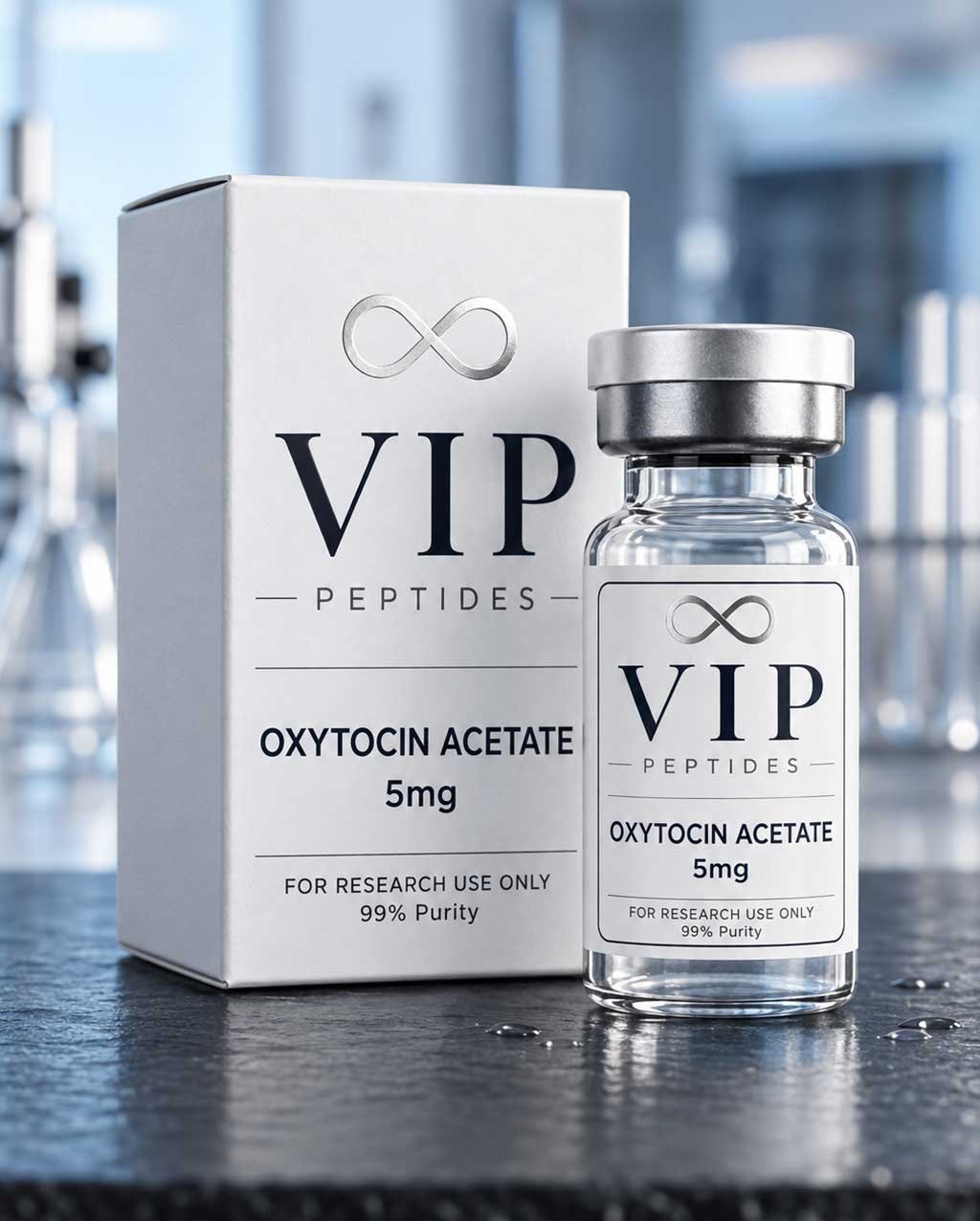
Oxytocin Research Profile
Oxytocin is a naturally occurring 9-amino-acid neuropeptide and hormone
produced primarily in the hypothalamus and released by the posterior
pituitary. This profile summarizes its established obstetric medical
uses and selected areas of ongoing research.
Peptide length
Primary receptor
Typical plasma half-life
Product classification
Product Information
About Oxytocin
Oxytocin acts on oxytocin receptors (OXTR) found in the brain and
throughout the body. Research has examined its interactions with
neurotransmitter systems, stress responses—including the
hypothalamic-pituitary-adrenal (HPA) axis—and autonomic function.
Oxytocin has established medical uses in obstetrics. Other proposed
applications, including social, psychiatric, and wellness uses,
remain research areas and should not be interpreted as established
clinical benefits.
Its plasma half-life is typically reported as approximately
3–6 minutes. Effects and research findings can vary by context,
route, and study design.
Research Profile
| Product | Oxytocin |
|---|---|
| Peptide length | 9 amino acids |
| Produced primarily in | Hypothalamus |
| Released by | Posterior pituitary |
| Primary receptor | Oxytocin receptor (OXTR) |
| Typical plasma half-life | Approximately 3–6 minutes |
| Product form | Confirm form and quantity against the product label |
Research Areas
What Research Has Examined
Social and Behavioral Research
Research—primarily involving intranasal administration—has explored
social cognition, trust, empathy, anxiety, stress buffering, and
aspects of sexual function. Findings are mixed, and results from
small studies do not establish a reliable clinical benefit.
Stress-Response Pathways
Studies have examined oxytocin’s relationship with stress responses,
including interactions with the HPA axis, as well as possible effects
on autonomic function. These research findings do not establish
treatment for anxiety or other conditions.
Pain and Recovery Research
Preclinical and limited human research has explored possible roles
in pain modulation and recovery processes. These early findings
require further study and do not demonstrate a proven therapeutic
effect.
Context-Dependent Effects
Oxytocin’s effects may depend on the individual and social context.
Some research suggests it can affect in-group preference, so it
should not be described as universally increasing trust, empathy,
or social connection.
Evidence Overview
Established Use and Research Limits
Injectable oxytocin has specific obstetric medical uses, including
induction or augmentation of labor and control of postpartum uterine
bleeding, under appropriate medical supervision.
Research into social cognition, anxiety, stress, sexual function,
appetite, and metabolic regulation has produced mixed results. Some
small studies have reported positive findings, while larger trials,
including research in autism spectrum disorder, have often shown
limited or no benefit on their primary endpoints.
Much non-obstetric behavioral research has used the intranasal route.
Findings from one route or research setting cannot be assumed to apply
to another.
Safety & Regulatory Status
Important Safety Information
In approved obstetric settings, oxytocin is administered with clinical
monitoring. Important risks can include uterine hyperstimulation and,
with prolonged high-dose infusion, water intoxication.
Mild effects reported in intranasal research include nasal irritation,
headache, and transient nausea. Injection-site reactions may occur with
injectable products. Long-term safety for repeated non-obstetric use is
less established.
Injectable oxytocin is approved for specific obstetric indications.
Intranasal and research-grade subcutaneous use for social, psychiatric,
or wellness purposes is not an FDA-approved indication and does not have
standardized dosing or established long-term safety data.
consumption, self-administration, diagnosis, treatment, cure, mitigation,
or prevention of disease. Any approved medical use of oxytocin belongs
under licensed healthcare supervision.

![FOXO4 (Proxofim) [10mg]](https://vipresearchpeptides.com/wp-content/uploads/2026/10/fox-300x300.jpg)
![AOD-9604 (Anti-Obesity Drug 9604) [10mg]](https://vipresearchpeptides.com/wp-content/uploads/2026/10/aod9604-300x300.jpg)

![Epitalon [50mg]](https://vipresearchpeptides.com/wp-content/uploads/2026/10/epitalon-1-300x300.jpg)
Reviews
There are no reviews yet.